Showing posts with label sanctuary notes. Show all posts

Sanctuary Notes: In Memory of Harold

Harold, the little black pygmy goat with the shortest legs and the deepest voice, was euthanized last week. Harold was special. He won the hearts of staff and visitors, first with his small stocky stature then with is big personality. He was buried near the rolling hills and rock piles he was to climb in Grass Valley, and his presence is missed on the steep hills in Vacaville.

Harold arrived at Animal Place five years ago. He was found tied to a fence at a slaughterhouse, sick, anemic, riddled with parasites, and practically blind. He was treated with antibiotics for his infections, dewormer for his parasites and anemia, and a slew of eye ointments to help his painful eyes recover. The vets questioned whether the corneal ulcers would rob him of his vision forever. Slowly, with gentle care he had most likely never known, received from people he couldn’t see, he started to improve. His anemia cleared, he could see, and he learned some people could be trusted.


He never really came around to being the most social of goats, except when he wasn’t feeling well. Harold sought attention when his teeth were causing him pain. He sought attention when he could feel the restriction of the mass growing in his lungs. Maybe he remembered the first time he was nursed back to health. When he started being social with people a month ago, we encouraged the interactions, picking leaves from the tree he could never reach. We soon noticed he had difficulty breathing. He was examined at UC Davis’s veterinary hospital and found to have a mass or abscess stealing a third of his lung space.


When they recommended restricted movement and isolation, we had a tough choice to make. We knew his time was coming to an end and couldn’t bear the thought of keeping him from his friends. In the end, we let Harold decide – did he want to spend his remaining days grazing alongside his goat friends? He stayed out with the herd. We gauged his quality of life as best we could.


Harold told us when it was time. His breathing worsened and he stopped going to graze with the goats. We scheduled a vet to come and euthanize him at the sanctuary, the only place he knew as home. When I scooped him up to take him to the stall for his last few minutes, his loss of weight and will to fight were shockingly apparent. The entire staff was there as the drugs were administered, and his labored breathing slowed, then stopped.

Deciding when to euthanize is definitely the hardest part of my job. We decide as a group, considering the observations and emotions of each staff member. Sometimes we arrive at the decision to euthanize at different points in disease progression. Regardless of our personal timing, it seems the animals always tell us when they are ready. It could be as dramatic as Val the pig showing us her legs no longer have the strength to lift her heavy body or as subtle as Nancy the goat gradually slowing down then losing the spark from her eyes. Of course its never easy, but having a consensus, especially with the animals, makes us feel more assured of our decision. Providing these animals with a great life includes helping them pass as painlessly as we can, as hard as that can be. I play the images of Harold scampering down the steep hills with his short gait, of him saying hello to the dentistry vet by planting his front hooves mid-thigh, of all the things that made Harold so uniquely Harold and they remind me we gave him the best life possible.

Sanctuary Notes: Etta and Me

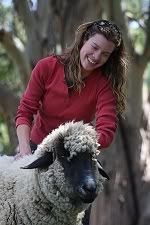
Etta was rescued from a live-market slaughterhouse a year ago. She arrived sick, emaciated and afraid of people. During the first months, she needed extensive medical care to help her gain weight and clear all infections. Her true personality emerged, and she is now a very outgoing sheep with a personality that steals hearts, including mine.

Etta had been favoring her right back leg for about a week. We worried she might have an abscess in her hoof or arthritis. We made an appointment with the vets for radiographs and an ultrasound at UC Davis. Getting her into the stock trailer was easy – she just followed me up the ramp. Once we closed the doors behind her and lifted the ramp, she started to worry and bellow loudly. I reached my hand through the trailer, touched her nose, and spoke quietly to her.

I parked the truck and stock trailer while Etta’s deep call echoed across the hospital parking lot. She quieted down when I peeked over the edge of the trailer, let her sniff my hand, and told her to stay for just a bit while I checked in. Her calling resumed instantly as I walked past the line of horse trailers towards the entrance. A woman brushing her horse’s mane and tail looked at me then back at my trailer and smiled, “your sheep sure does miss you”.

“She is my favorite lady,” I smiled back.

I unloaded Etta and waited for the students and the vet to arrive. Etta was nervous; her pupils were dilated and her breaths short, but she was quiet. She stood next to me and leaned heavily into my leg while I scratched her back. The vet was running late, so I left Etta in the room to grab some work from the truck. I ran into another vet who has treated Etta numerous times and knows the animals by name. Shouting over Etta’s nervous calls she said, “Etta really loves you.” I smiled, gave her the short version of why we were visiting and returned to our room. Etta was waiting by the door and re-glued herself to my leg. The staff arrived and gave her a physical. (She was up 40 pounds from her arrival weight! It took all my self-control not give the staff a round of high fives.) They wanted to assess Etta’s walk, but she was nervous and tried to dart away from them. So she and I made a tightly linked train (I the engine and she the caboose) circling the perimeter of the room clockwise then counter-clockwise for quite a few rounds.

The vet left to grab supplies from the pharmacy and the vet tech stayed to chat. He kept his eyes on Etta as he told me about his family’s beef cattle ranch near our new property in Grass Valley. I invited him to visit after we move. I noticed a connection when he said, kind of surprised, “she is really bonded to you.” The vet returned with Etta’s diagnosis: her arthritis is worsening probably related to her previously difficult life. Not much could be done except to provide pain management.

It hit me that maybe my bond with Etta wasn’t completely one sided, and that maybe she actually got something out of being around me, too. It never fails to excite me seeing how profound an impact the animals and their behaviors have and how apparent their emotions can be to people. I hope you have time this summer to attend one of our tours and spend time at the sanctuary. You’ll be amazed at the bonds the animals have with one another and the bonds they will form with you.

Sanctuary Notes: Caring for “meat” chickens

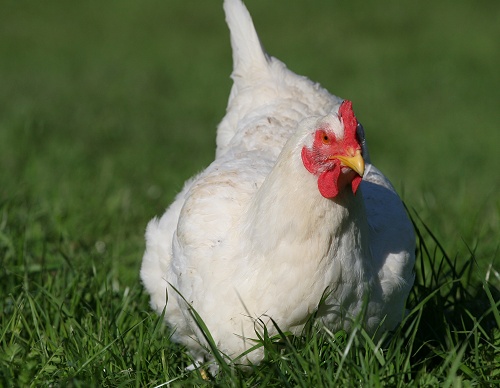
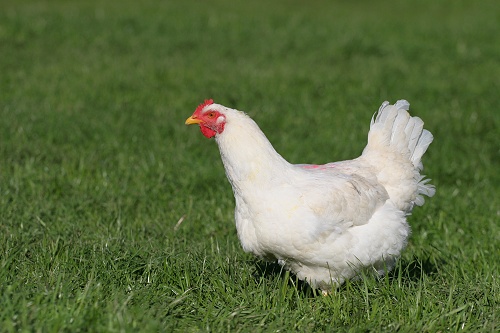
Nico, Fran and the “broiler” chicken crew are among the most social critters at the sanctuary. They run towards visitors, inquisitively cock their heads to the side, give you the “chicken eye”, and wait for any sign of melons. These birds always make an impression on visitors (mostly good but sometimes a little intimidating when they jump up and mistake a finger for a grape) because of their larger than life personalities and size.


These chickens came from two rescues. The first group arrived after Hurricane Katrina destroyed a Mississippi broiler facility (Animal Place helped pull 1,100 young birds) and the second when Oakland Animal Control confiscated dying birds being shipped (legally) through the mail at only a day of age. It may shock you, but these birds are killed at only 6-weeks-old, just babies! Nine billion of them are slaughtered every year…they aren’t protected by federal or many state laws, so they can be housed and killed in any way.


And when they are saved, these birds fight against generations of genetic selection for birds who could gain a rapid amount of weight in a short amount of time. They have a lot of health problems. We monitor their health with monthly checks and manage their weight with special feeding schedules. (The ladies call it dieting, and they aren’t too fond of it.) Breakfast and dinner consist of chicken feed mixed with low calorie rice hulls, and lunch is a healthy helping of lettuce, grapes, and melons. Despite our efforts, these chickens have a much higher incidence of foot infections, heart problems, and premature death than the smaller laying chickens. In fact, of the 100 birds who arrived from Hurricane Katrina, nearly half died from heart attacks and heat stroke within the first year.


Hannah, a Katrina rescue, has a foot infection called bumblefoot that is caused by her weight. Hannah likes pecking at the dirt looking for tasty treats and is one of the first to bound over to visitors, but the constant pressure from her favorite pastimes cause her feet to develop sores which become infected. Foot sores can take many months to heal, are terribly painful, and require treatment with oral antibiotics and twice weekly foot soaks, flushing, and wrapping. We wrap a disc from a styrofoam pipe insulator to the bottom of the infected foot to help keep the weight off the painful center of the foot. Another disc is attached to the good foot to keep the girls from being lopsided while wearing only one platform shoe. You should see the confused look on the faces of the hardware store clerks when I explain why I need pipe insulators in summer!


Last month we were closely monitoring Matt, the lone rooster from the Oakland rescue, because he had started wheezing and quit crowing. We were afraid his unnatural size was leading to an early death by heart failure, a very common and abrupt ending sanctuaries see with many young “meat” birds. We gave a dewormer in case lung parasites were making it more difficult for him to breathe, monitored his feeding closely, and started to weigh him weekly. After a week of treatment he wasn’t wheezing anymore, but was still breathing loudly. A few days later we heard him crow again for the first time. We hope that keeping his weight down will help Matt live to the ancient broiler chicken age of 4 years.


Although the broiler ladies and Matt have much shorter lifespans and can develop serious health problems due to their genetics, they don’t let it get them down. At the sanctuary, they live the good chicken life and remind us that grapes, grass, sunshine, are some of the best things in life.