We are moving to a new blog at tumblr.
All content here will remain up for archival purposes,but all new postings will be over at our new blog.
Hope to see you there!


Blessing of the Animals
This past Saturday, Venerable Geshe Thupten Phelgye will visited the sanctuary to bless the rescued animals. He founded the Universal Compassion Movement, serves as a member of the Tibetan Parliament in Exile and promotes a vegetarian diet. Learn more about him(links to his website)
Additionally, you may wish to visit Dharma Voices for Animals and find out how compassion towards nonhumans can be integrated into spiritual teachings.
Our local paper did a nice story on it - read here.


The Joys of Chicken Sweaters
If you don't visit our website (and you should!) or our facebook page (what?!), then you might not have seen the photos of the chickens in their new sweaters!
A knitting club created 10 sweaters for the birds to try out. The chickens live in a really large barn and it can be hard to keep them warm at night.
The risk of fire means we cannot use heat lamps, so we have to find other creative ways to keep the birds cozy. Chickens are descendents of wild jungle fowl and really dislike the cold. They can even get sick.
The egg-laying breeds suffer the most, as they are wasting all their energy on producing eggs, they are not laying down fat and muscle.
A knitting club created 10 sweaters for the birds to try out. The chickens live in a really large barn and it can be hard to keep them warm at night.
The risk of fire means we cannot use heat lamps, so we have to find other creative ways to keep the birds cozy. Chickens are descendents of wild jungle fowl and really dislike the cold. They can even get sick.
The egg-laying breeds suffer the most, as they are wasting all their energy on producing eggs, they are not laying down fat and muscle.
 |
| Sunny loved her sweater! |
 |
| Killer poses nicely with his |
 |
| Big Red looks nice in pink |
 |
| Sharktooth didn't exactly enjoy the new outfit |
Rats Are Cool
All the rats had outdoor time. They loved it. Oliver was especially smart. He was snake bait originally, but the snake was full and Oliver lucked out. I taught him to hi-five, sit, shake, paw, stand on his back legs and "beg". It was easy with the power of the apple. Oliver loved apples. But is favorite time was after the training. I'd tell him "all finished" and give him two small bits of apple. He would hoard them.
As we passed by Thelma and Louise's open cage door, both of the girls would be standing on the ledge. I would drop Oliver off and he'd rush over to Thelma and give her the BIGGEST apple piece. Despite Louise's rudeness to him, he'd always give her the other piece. But it was always the smallest one. In those moments, I knew rats possessed myriad emotions and thought, that they could make decisions based on perceived fairness, and that they were compassionate and generous.
When Louise died of mammary cancer, it was (neutered) Oliver who comforted Thelma. When Thelma became sick with cancer, Oliver wrapped himself around her. She died in his embrace. By that point, Oliver was nearly 3 years old, ancient in rat years. He died a week later.
So it is not surprising to me that researchers have learned what people with companion rats have known all along - rats are empathetic.
In the experiment, two rats are socialized around each other for two weeks. Once they become friends, researchers performed a mean trick on one of the rats. She would be placed in a tube that prohibited movement. The tube would be placed back in the cage with the other rat. The other rat would then find a way to break out her friend, even ignoring chocolate to help her cagemate. She'd then share the chocolate!
Rats are not "lowly" animals. They are intelligent, thoughtful and even empathetic. When they see the suffering of a friend, they do not merely understand or experience those emotions themselves, they try to rectify the situation. That is pretty neat.
You can help rats! If you have the space and time to commit to caring for a rat, adopt two! There are many rats in shelters who face euthanasia because people fail to realize how awesome rats are as companions.
Never use poisons or kill traps to stop rats. Instead, use humane live traps to capture and relocate rats to safe areas where they can thrive. Prevent rats from even entering your property to begin with!
And of course, we believe other species, like cows and pigs, are just as empathetic as rats. We've seen it. So if you want to help them, start transitioning over to a vegan lifestyle...you can be empathetic too!
PS: You can see video of the rats here.
Cheese Alternatives
We opened a dialogue on our Facebook page about the animal products vegans/vegetarians had the hardest time giving up and how they coped. A lot of veg-curious and vegetarian individuals were having (or had) a hard time with cheese.
This isn't entirely unexpected. Milk from cows contains casein which, when broken down, produces casomorphins. These protein fragments act upon the brain in similar ways as other opiates (morphine, codeine, heroin). Cheese contains a concentrated amount of casein. Our brain can become addicted to these casomorphins, making the elimination of cheese particularly difficult.
So be kind to yourself if you are a cheese-lover desiring to move towards a kinder way of living. You may want to eliminate all dairy cheese so that your body can detoxify itself. Or you may wish to slowly replace your favorite cheese products with alternatives that are not addictive.
I put together this list of animal friendly alternatives to dairy cheese. Many of these are commercially available at natural food stores, Whole Foods, and several large grocery chains. If they are not, they can be ordered online and shipped to you. Of course, you can also make your own cheeses so I have included a few recipes for that.
Sheese
Sheese is available in two forms: hard and soft. They do contain soy protein but are gluten-free.
Flavors available:
How to order: Online
Daiya
Daiya is commercially available in shredded form. It does not contain soy. It is becoming more and more easily available to the public.
It comes in cheddar, mozzarella and pepper jack.
Uses: Great for pizza, calzones, vegan french onion soup (FOR REALS!), anything you need really melty cheese!
Find out if it's available in a store near you
Teese
Chicago SoyDairy also makes vegan marshmallows and why isn't their soft serve vegan ice cream in my living room? Seriously. It does contain soy.
It comes in mozzarella, cheddar and nacho. It comes in a tube of awesome.
Uses: Great on pizza, awesome on nachos, mac n' cheese, good for grilled cheese sammiches.
Where to buy
Nacheez
Nacheez comes in a jar of goodness and is made from cashews, so it is soy free. It is available in mild and spicy flavors.
Uses: Perfect for those of us who loved Velveeta style mac 'n cheese, stadium style nachos, and who just likes to scoop spicy nacheez out of a jar on to our chips (or just into our mouths!)
Where to buy
Dr. Cow
If you are a cheese snob of any kind, this is the animal friendly alternative for you! Seriously. It's like super woah expensive and absolutely divine. It is soy free.
Uses: STUFF INTO YOUR MOUTH AND SMILE.
Where to buy
Make Your Own
Cashew Nut Cheese
Vegan feta cheese
Buy The Uncheese Cookbook
This isn't entirely unexpected. Milk from cows contains casein which, when broken down, produces casomorphins. These protein fragments act upon the brain in similar ways as other opiates (morphine, codeine, heroin). Cheese contains a concentrated amount of casein. Our brain can become addicted to these casomorphins, making the elimination of cheese particularly difficult.
So be kind to yourself if you are a cheese-lover desiring to move towards a kinder way of living. You may want to eliminate all dairy cheese so that your body can detoxify itself. Or you may wish to slowly replace your favorite cheese products with alternatives that are not addictive.
I put together this list of animal friendly alternatives to dairy cheese. Many of these are commercially available at natural food stores, Whole Foods, and several large grocery chains. If they are not, they can be ordered online and shipped to you. Of course, you can also make your own cheeses so I have included a few recipes for that.
Sheese
Sheese is available in two forms: hard and soft. They do contain soy protein but are gluten-free.
Flavors available:
- Hard: Strong cheddar (my fave), Blue, Cheddar with chives, Cheshire, Edam, Gouda, Medium Cheddar, Mozzarella, Smoked Cheddar.
- Soft: Cheddar, Chives, Garlic & Herb, Mexican, Original
How to order: Online
Daiya
Daiya is commercially available in shredded form. It does not contain soy. It is becoming more and more easily available to the public.
It comes in cheddar, mozzarella and pepper jack.
Uses: Great for pizza, calzones, vegan french onion soup (FOR REALS!), anything you need really melty cheese!
Find out if it's available in a store near you
Teese
Chicago SoyDairy also makes vegan marshmallows and why isn't their soft serve vegan ice cream in my living room? Seriously. It does contain soy.
It comes in mozzarella, cheddar and nacho. It comes in a tube of awesome.
Uses: Great on pizza, awesome on nachos, mac n' cheese, good for grilled cheese sammiches.
Where to buy
Nacheez
Nacheez comes in a jar of goodness and is made from cashews, so it is soy free. It is available in mild and spicy flavors.
Uses: Perfect for those of us who loved Velveeta style mac 'n cheese, stadium style nachos, and who just likes to scoop spicy nacheez out of a jar on to our chips (or just into our mouths!)
Where to buy
Dr. Cow
If you are a cheese snob of any kind, this is the animal friendly alternative for you! Seriously. It's like super woah expensive and absolutely divine. It is soy free.
Uses: STUFF INTO YOUR MOUTH AND SMILE.
Where to buy
Make Your Own
Cashew Nut Cheese
Vegan feta cheese
Buy The Uncheese Cookbook
Shop With Us and the Animals

And if you do not celebrate the holidays, check out our Sanctuary Store!
That's right, our sanctuary store is an equal opportunity provider of awesome stuff!
You can foster an animal from a distance. Or you can wear your vegan love with one of our Peace Love Vegan shirts. While you are fostering an animal, wearing your vegan shirt, you can be drinking out of our reusable stainless steel Choose Compassion With Every Action water bottle WHILE READING OUR 2012 CALENDAR! Freaking amazing, I think!
That is all, folks. I mean, for now, not forever.
Meet the Turkeys - Walle
You would have liked Walle, the baby. Trust me on this. Your lap would have been his bed. You could fumble in your words with him, and he would understand. He was patient.
You would have fallen more in love with Walle the adult. Although he followed Morris, he did not emulate his larger friend's aggressiveness with humans. He could make his own choices. You would have marveled at his velvet soft head, his strange drooping snood, his grandiose attempts at puffing himself up to show off.
Walle lived a year with us. He had been mutilated. He had been bred for the sole purpose of getting fat to be killed young. The farm's overcrowding increased his risk for disease. He struggled the time he was with us. Struggled to grow. Strained to breath with compromised lungs. Too much damage had been done. With one heaving breath, he died, watched over by those who cared and respected him deeply.
Trust me, you would have loved Walle. And in his perfect avian way, he would have loved you back.
Meet the Turkeys - Creek
Creek is a baby turkey. He is the size and weight of a turkey raised for Thanksgiving slaughter. He bears the scars of from wherever he came - the tip of his beak has been cut off as have the first digits of his toes. This is done without pain relief and to minimize overcrowding and handling issues.
Unlike his sister, Miwok the Ewok (who you will meet next week), Creek is a moody turkey. Like all turkeys, Creek can change the color of the skin around his head and neck in a millisecond! The color changes indicate mood. Really red and vibrant can mean angry or "I'm hot stuff", depending on other cues. A very pale face can indicate stress or shyness or "I'm not really here, don't look". A happy turkey is one who has a mix of red, especially alongside his neck, and some blue around his face.
Creek tends to be angry.
Except when he's hanging with Miwok the Ewok. Then he's all sweet and lovey-dovey.
Meet the Turkeys - Serena and Zarriah
 |
| I am Zarriah. Obey my commands! |
For two turkeys who spend most of their time together, I have no pictures of them doing just that.
Both turkeys came from the same farm (probably as Maya). They were being raised for Thanksgiving dinner. Most likely sisters, the two turkey poults escaped the farm and were saved by an individual.
Neither turkeys are particularly fond of people. And it's been like 11 years, so they really hold a grudge.
Unlike large production birds, Serena and Zarriah can fly. They can mate normally. They self-regulate their diet, so they can be free-fed. Their longevity stems from a strong tie physically to that of their wild cousins.
Speaking of wild turkeys. When settlers arrived in what would be the United States, they did what people do best and proceeded to nearly wipe out all wild turkeys (and everyone else who was a native). The great irony is that the reason numbers increased from 30,000 in 1900 to 5 million now is through the efforts of hunters who wanted to hunt the birds. Weird!
 Back to Serena and Zarriah. Obviously they are not wild turkeys. Being black and white in woodland brush is not a highly survivable coloration.
Serena here is sporting a nifty thing called a beard. It's the hair hanging from her chest. You can guess how old a turkey is from their beard. Both males and females may sport a beard, although it's more commonly found in males as it is also a way for older tom turkeys to attract females (I'm alive and successful, yo).
Serena and Zarriah hang out with Maya. They don't care for Willow, ignore Margaret, and completely ignore the big white-breasted turkey hens and toms. Sometimes they snuggle with the chickens, although I think in this photo, Serena was just being lazy.
Since Serena and Zarriah are sort of a mystery to me, I figure their recipes should be about casseroles, which are also a mystery to me (as in I'm befuddled by their popularity).
And well, that's all you are going to get from me. There is a Serena and a Zarriah, so there is a Green Bean Casserole and a Green Bean Casserole #2.
Meet the Turkeys - Wild Side
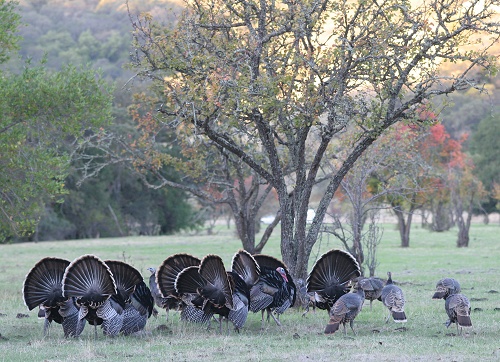
Wild turkeys are the only native North American species to be domesticated (probably not their proudest moment). I want to share a few stories of my experience with them at both sanctuaries. These moments encapsulate the wildness of these animals and the cruelty of humans as much as they do the mystery of turkeys and the compassion of people. Wild turkeys don't like recipes, so look for more in tomorrow's edition.
Finding a Safe Spot
We do not know from where she came, this wild turkey hen. She is not with her clan. Instead, she flies, all muscle and pure grit, into the domestic chicken and turkey enclosure. The toms display, she ignores. At the time, we assume she is looking for comfort. A month passes and we see the reason why she has chosen the predator proof pasture. Four healthy poults. She flies over, they are stuck. She flies back, encourages them to follow. They cry their frustration. Finally they find a space to fit through. Off they go.
Ruffled Feathers and Buckshot
She sat stunned along the road. It looked as if she had been caught in the force of speeding cars. Pulling over, a towel is draped over her huddled form. She does not resist. We give her time, antibiotics, pain medications. She does not get better. We have a vet look at her. She finds buckshot embedded in her small body, infection gone systemic, ravaging her organs. No one talks much about these hunted animals, the ones who "get away". Who take weeks to die, in prolonged agony and suffering. We give her the only comfort we can - a peaceful death.
The Wretched Fence
Eight turkey poults wander up and down the sanctuary fence, crying angry and annoyed. Scared to push them closer to the road, time is spent reading a book while the turkey babies figure out this novel device. Finally - oh thank goodness finally - one looks up instead of straight at their moms. She cocks her head to the side, crouches low, and in a gust leaps over the fence. One by one they figure it out, except for two. Book closed, time now to watch these amusing babies learn something about their world. At the same time, the two poults pace five feet back, run forward, and leap on the fence. But! One cannot fairly share the same moment in space and time with another, so the two jesters fall tail feathers over soft heads onto the ground. Mom runs over, checks in on both, chastises them for their silliness, and wanders off. The two poults dust themselves off. Turkeys: 6 Fence: 2.
The Cry Louder Than The Shot
Feeding the potbellied pigs, their demands for attention damaging eardrums, the shot might have gone unnoticed. But it was not one, "clean" shot. It was three. The echo reverberated. The cry came next. It overshadowed the pigs. It's ache and tenor pierced the shotgun's power. The turkey screamed, struggling to stand up. A final shot ended his life. The other turkeys did not leave him. Surrounding their fallen brethren, they trilled and gobbled their anger and fear. Only when the one with the gun came close did they fly frantically away. It was Thanksgiving.
 The Mighty Quinn
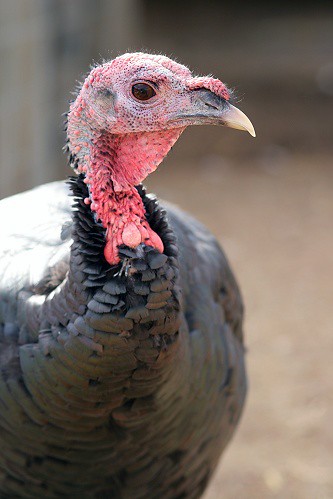
What an honor, naming this majestic bird. As a failed member of the Wildlife Rehabilitation School, Quinn made it known to all that he was still cooler than you. He took on the big toms. He wooed the ladies. He convinced his partner in crime, Maya, to roost up in trees, perch on buildings, and wander into the unsafe zone. Quinn was a revolutionary. Should have been named Che. Soon another turkey joined him, then another. Even the chickens were ready for a coup. The toms were ready for him to go, the roosters annoyed at his gumption. Caregivers stomped and waved arms wildly, demanding he stop trilling 25' off the ground. Like a good revolutionary, he flipped them the bird and went about his business. Wild animals are wild animals. Lesson learned. Quinn was run out of town, the dictators had won! He moved to a new city, where he could be safely fenced in but not cooped up, where he could roost in trees without fear of being shot out of one. Where he could make speeches to people and not worry they might kill him for speaking the truth. Plus he got a girlfriend.
Previous turkey entries
Finding a Safe Spot
We do not know from where she came, this wild turkey hen. She is not with her clan. Instead, she flies, all muscle and pure grit, into the domestic chicken and turkey enclosure. The toms display, she ignores. At the time, we assume she is looking for comfort. A month passes and we see the reason why she has chosen the predator proof pasture. Four healthy poults. She flies over, they are stuck. She flies back, encourages them to follow. They cry their frustration. Finally they find a space to fit through. Off they go.
Ruffled Feathers and Buckshot
She sat stunned along the road. It looked as if she had been caught in the force of speeding cars. Pulling over, a towel is draped over her huddled form. She does not resist. We give her time, antibiotics, pain medications. She does not get better. We have a vet look at her. She finds buckshot embedded in her small body, infection gone systemic, ravaging her organs. No one talks much about these hunted animals, the ones who "get away". Who take weeks to die, in prolonged agony and suffering. We give her the only comfort we can - a peaceful death.
The Wretched Fence
Eight turkey poults wander up and down the sanctuary fence, crying angry and annoyed. Scared to push them closer to the road, time is spent reading a book while the turkey babies figure out this novel device. Finally - oh thank goodness finally - one looks up instead of straight at their moms. She cocks her head to the side, crouches low, and in a gust leaps over the fence. One by one they figure it out, except for two. Book closed, time now to watch these amusing babies learn something about their world. At the same time, the two poults pace five feet back, run forward, and leap on the fence. But! One cannot fairly share the same moment in space and time with another, so the two jesters fall tail feathers over soft heads onto the ground. Mom runs over, checks in on both, chastises them for their silliness, and wanders off. The two poults dust themselves off. Turkeys: 6 Fence: 2.
The Cry Louder Than The Shot
Feeding the potbellied pigs, their demands for attention damaging eardrums, the shot might have gone unnoticed. But it was not one, "clean" shot. It was three. The echo reverberated. The cry came next. It overshadowed the pigs. It's ache and tenor pierced the shotgun's power. The turkey screamed, struggling to stand up. A final shot ended his life. The other turkeys did not leave him. Surrounding their fallen brethren, they trilled and gobbled their anger and fear. Only when the one with the gun came close did they fly frantically away. It was Thanksgiving.
The Mighty QuinnWhat an honor, naming this majestic bird. As a failed member of the Wildlife Rehabilitation School, Quinn made it known to all that he was still cooler than you. He took on the big toms. He wooed the ladies. He convinced his partner in crime, Maya, to roost up in trees, perch on buildings, and wander into the unsafe zone. Quinn was a revolutionary. Should have been named Che. Soon another turkey joined him, then another. Even the chickens were ready for a coup. The toms were ready for him to go, the roosters annoyed at his gumption. Caregivers stomped and waved arms wildly, demanding he stop trilling 25' off the ground. Like a good revolutionary, he flipped them the bird and went about his business. Wild animals are wild animals. Lesson learned. Quinn was run out of town, the dictators had won! He moved to a new city, where he could be safely fenced in but not cooped up, where he could roost in trees without fear of being shot out of one. Where he could make speeches to people and not worry they might kill him for speaking the truth. Plus he got a girlfriend.
Previous turkey entries