By now, you've probably read or seen one of the over 2,000 media accounts involving the cruel treatment of cows sent to slaughter and the subsequent recall of 143-million pounds of beef. Cruelty charges are being laid, schools are making sure their beef isn't from the Chino, CA slaughterhouse and legislation is being proposed to close a loophole that permits downed animals from entering the human food chain.
We are duly impressed with the coverage this industry-standard cruelty is receiving. It's about time. We don't want it to overshadow the fact that this slaughterhouse is not unique, and the treatment of these animals not aberrant within animal agribusiness.
A big thank-you to the Humane Society of the United States and their dedicated undercover investigator for exposing this cruelty.
Times are changing, and we believe it will be for the better.
How You Can Help:
1) Press Pause: That's right, pause and consider your dietary choices.
If the time isn't right for a vegan diet, reduce your consumption and nominate a day of the week as your Meat-Out day.
If the time is right (and we hope it is!), go vegan!
There are a plethora of mouth-watering and tasty-recipes available on the internet and at your local bookstore!
Try Veganomicon, Vegan with a Vengeance, Vegan Planet, How it all Vegan, and the very important Vegan Cupcakes Take Over the World.
Becoming vegan is a fun experience - it is a kindness we extend to the animals, our bodies and the planet. A win-win situation for all, really.
2) Contact the USDA: Contact USDA secretary of agriculture, Edward Schafer.
Ask him to:
- close the loophole permitting such blatant cruelty to animals.
- stop allowing downed animals to enter the food chain.
- require USDA inspectors spend more time present at federally-inspected slaughterhouses.
Email: Edward.W.Schafer@usda.gov
3) Change the Menu: Here's a truth animal agribusiness doesn't like to share: the beef that ends up in government-funded school programs come from sick, diseased, overworked dairy cows.
Why? It's cheap.
And the solution shouldn't be to just buy meat from other slaughterhouses. It should include a serious reflection on what we do and do not want to teach our children. If we want to imbue a sense of compassion, of what is right and what is wrong, then perhaps we should encourage a trend of vegan menu options, instead of replacing one cruel product with another. After all, there is no escaping this fact: in order to produce cheap meat at a fast pace, animals must be mistreated from birth to death.
What you can do: Visit CHOICE, a website that will assist you in getting vegetarian menu options available in your child's school. If you're a teenager, advocate on behalf of the animals and encourage menu changes at your school.


Triple threat - Bovine buddies
It's time for a meet and greet. Let's start with Animal Place's cattle because, hey!, we only have three…
The slideshow shows off our dapper bovines, enjoy!
Nicholas
From backyard "trash" to sanctuary star, Nicholas is the darling of the sanctuary with his mocha eyes, long lashes and playful attitude.
Age: 1.5 months
Breed: Jersey
Color: Brown (or a pale mocha…)
Likes: Chewing on scarves, hair, grass, pot-bellied pigs, hay, neck skritches
Dislikes: Not being fed exactly on time, goats who stare at him
Story: Nicholas was found tied in a yard, auction stickers glued to his body. He was only two-days-old. Animal Control confiscated him, called us and bam! Nicholas was on his way to his new digs. Nicholas is a by-product of the dairy industry; an unwanted male calf destined for the veal crate or a backyard slaughter.
From abused dairy cow to Howie-seducer, Sadie is now Queen Cow at the sanctuary.
Breed: Holstein
Color: Penguin black-and-white (but don't mention the penguin part to Sadie)
Likes: Alfalfa, handsome steers, full-body massages, apples
Dislikes: Frisky steers, pigs, medicine
Story: Sadie was a dairy cow. Contrary to popular belief, there are no happy pastures for retired dairy cows – they're slaughtered at a young age. When she was about six, Sadie was sent to auction for eventual slaughter. A veterinary university bought her so that students could poke and prod before selling her back at auction…what a great lesson to teach! A vegan vet student coordinated her rescue, and now she spends her days grazing with Howie and talking to Nicholas.
From a shelter night-drop box to wheelbarrow-crushing steer, Howie is our loveable lug of a bovine.
Breed: Charolais
Color: Sandy brown
Likes: Wheelbarrows (the tipping of), hay, pears, apples, watermelon, cantaloupe, carrots, sweet potatoes, head-butting the pigs
Dislikes: Head-butting goats, having to move out of anyone's way
Story: Howie's mom died giving birth. The farmer stuffed the one-day-old calf into a drop-off box at a shelter. When FFA (Future Farmers of America) heard about the calf, they wanted to raffle him off to the highest bidder…so they could kill him. And the shelter was okay with that! Animal Place garnered media attention and, smartly, the shelter agreed to place Howie with us. Twelve-years-later, Howie thrives and quite popular with visitors.
Rethinking the meat guzzler
A New York Times article by Mark Bittman details the effects meat production has on our environment. Health problems and animal cruelty are mentioned in passing.
http://www.nytimes.com/2008/01/27/weekinreview/27bittman.html?_r=1&ref=world&oref=slogin
If you do not have a NY Times account, get a free log-in id from www.bugmenot.com (just enter the URL in the search box).
Highlights:
- The United States comprises 5% of the world's population, yet slaughters 15% of the world's total farmed animals (10 billion).
- A third of all ice-free land is directly/indirectly involved in meat, dairy and egg production.
- Nearly 20% of all greenhouse gases are produced by the livestock industry.
- Two to five times more grain is required to produce the same caloric amount through livestock than direct consumption of grain.
- Americans consume twice the maximum, suggested allowance of animal protein a day! Humans only need about 30 grams of protein a day, yet Americans consume around 110 grams.
The production of animal products is a burden to the environment, our bodies and necessarily cruel to animals.
Reduce and eliminate - it isn't hard to do!
http://www.nytimes.com/2008/01/27/weekinreview/27bittman.html?_r=1&ref=world&oref=slogin
If you do not have a NY Times account, get a free log-in id from www.bugmenot.com (just enter the URL in the search box).
Highlights:
- The United States comprises 5% of the world's population, yet slaughters 15% of the world's total farmed animals (10 billion).
- A third of all ice-free land is directly/indirectly involved in meat, dairy and egg production.
- Nearly 20% of all greenhouse gases are produced by the livestock industry.
- Two to five times more grain is required to produce the same caloric amount through livestock than direct consumption of grain.
- Americans consume twice the maximum, suggested allowance of animal protein a day! Humans only need about 30 grams of protein a day, yet Americans consume around 110 grams.
The production of animal products is a burden to the environment, our bodies and necessarily cruel to animals.
Reduce and eliminate - it isn't hard to do!
Pigs don't want that honor
In the UK, there's been a lot of open discussion about food choices. We have Jamie Oliver televising the killing of a chicken and smothering of male chicks. Eggs from battery caged hens will be banned by 2012 and gestation crates are already being phased out. News stories detail the journey of families choosing to raise animals, name them, pet them, claim they "love them", and then slit those cherished ones throats.
Here's one of those stories: Compassionate Carnivores
For several months, this family took superb care of two pigs, Gnasher and Rasher and then murdered them. Can you imagine doing that to your companion dog or cat? Look them in the eye and say, "Hey, it's been a great six months - time to shoot you in the head and eat you!" In countries (like the UK) where dogs and cats are viewed as "companion animals", there would be outrage both moral and legal. Yet there is nothing intrinsically different about the emotional capacity, ability to feel pain, ability to relate to people or intellectual capabilities betwen pigs and dogs...why is one "food" and the other a "companion"?
The article goes on to quote philosopher Roger Scruton, who writes, "Duty requires us therefore, to eat our friends".
It might just be me, but that has to be one of the creepier philosophical opines. When I look at my friends, I'm not sizing up their hams or determining how long their meat will last in my freezer. I don't tell my friends that I love them so much, sorry about the whole I have to slit your throat and eat you bit. No one wants to be friends with someone whose going to kill and eat them. The human family raising Gnasher and Rasher were not their friends - they were humans who could not see past their momentary gustatory wants and desires. There is nothing friendly about the end result for Gnasher and Rasher.
"The animal brought to the table will have enjoyed the friendship and protection of the one who nurtured him, and his death will be like the ritual sacrifices described in the Bible and Homeric literature - a singling out of a victim, for an important office to which a kind of honour is attached."
I really wish these so-called "compassionate carnivores" would stop couching the killing of friends in such euphemistic ways. Honor? Important office? Friendship and protection?
I doubt Gnasher and Rasher were particularly honored about the whole throat-slitting business. Farmed animals would probably be okay without the honor, friendship, protection and ascension to an important office that humans want to give them. Knowing farmed animals (and I do), they would like to graze, snooze, meander around looking for food, play, annoy each other, make friends, fight, make babies, and live their life according to their emotions, instincts, and preferences (kinda like people, really). They have little interest in being eaten.
As always, it boils down to this fact: We don't need meat to survive. Being "friends" with your "food" doesn't change this fact, nor does it make the rather brutal violation of trust any more or less cruel than the way animals are treated on factory farms. Killing other living, sentient beings - when we don't need to - is not compassionate, kind, nice, friendly, protective or any other adjective guilt-ridden humans want to think up. It's actually quite petty and mean.
Now, we are all on our own paths. Some of us arrive at the aforementioned conclusion sooner than others. Some of us never arrive. For the animals' sakes, please consider eliminating meat, dairy and eggs from your diet. If you aren't ready for that commitment, at least limit your meat and dairy intake - choose to eat heart and planet healthy.
Here's one of those stories: Compassionate Carnivores
For several months, this family took superb care of two pigs, Gnasher and Rasher and then murdered them. Can you imagine doing that to your companion dog or cat? Look them in the eye and say, "Hey, it's been a great six months - time to shoot you in the head and eat you!" In countries (like the UK) where dogs and cats are viewed as "companion animals", there would be outrage both moral and legal. Yet there is nothing intrinsically different about the emotional capacity, ability to feel pain, ability to relate to people or intellectual capabilities betwen pigs and dogs...why is one "food" and the other a "companion"?
The article goes on to quote philosopher Roger Scruton, who writes, "Duty requires us therefore, to eat our friends".
It might just be me, but that has to be one of the creepier philosophical opines. When I look at my friends, I'm not sizing up their hams or determining how long their meat will last in my freezer. I don't tell my friends that I love them so much, sorry about the whole I have to slit your throat and eat you bit. No one wants to be friends with someone whose going to kill and eat them. The human family raising Gnasher and Rasher were not their friends - they were humans who could not see past their momentary gustatory wants and desires. There is nothing friendly about the end result for Gnasher and Rasher.
"The animal brought to the table will have enjoyed the friendship and protection of the one who nurtured him, and his death will be like the ritual sacrifices described in the Bible and Homeric literature - a singling out of a victim, for an important office to which a kind of honour is attached."
I really wish these so-called "compassionate carnivores" would stop couching the killing of friends in such euphemistic ways. Honor? Important office? Friendship and protection?
I doubt Gnasher and Rasher were particularly honored about the whole throat-slitting business. Farmed animals would probably be okay without the honor, friendship, protection and ascension to an important office that humans want to give them. Knowing farmed animals (and I do), they would like to graze, snooze, meander around looking for food, play, annoy each other, make friends, fight, make babies, and live their life according to their emotions, instincts, and preferences (kinda like people, really). They have little interest in being eaten.
As always, it boils down to this fact: We don't need meat to survive. Being "friends" with your "food" doesn't change this fact, nor does it make the rather brutal violation of trust any more or less cruel than the way animals are treated on factory farms. Killing other living, sentient beings - when we don't need to - is not compassionate, kind, nice, friendly, protective or any other adjective guilt-ridden humans want to think up. It's actually quite petty and mean.
Now, we are all on our own paths. Some of us arrive at the aforementioned conclusion sooner than others. Some of us never arrive. For the animals' sakes, please consider eliminating meat, dairy and eggs from your diet. If you aren't ready for that commitment, at least limit your meat and dairy intake - choose to eat heart and planet healthy.
Supergerms, it's what's for dinner!
Safeway sold ground beef containing multi-drug resistant Salmonella bacteria. The beef was sold in Arizona, California, Hawaii, Nevada and New Mexico between September 19 and November 5, 2007.
http://www.reuters.com/article/domesticNews/idUSN2129170720071221
But don't worry, folks! Food Safety Inspection Service (FSIS) believes no one should be concerned since the beef is no longer be sold. I mean I'm glad they aren't selling ground beef dated September 2007, but isn't that sort of missing the point? (Rhetorical question, people).
What these reports miss is the fundamental problem: the confinement of thousands of animals in small quarters. Cattle raised for consumption spend most of their days on feedlots, where up to 150,000 animals are contained. Animals can barely turn around, let alone lie down and stand up comfortably. There are no green pastures and animals are fed a high-energy diet that causes gut and leg problems.
The reality is that animals confined in such tight quarters get sick easily and spread disease quickly. So instead of decreasing the number of animals housed (how would people get cheap beef?!?) or expanding enclosures (how would farmers make more money?!?), producers feed antibiotics subtherapeutically.* Cattle no longer spread disease to one another, they spread antibiotic-resistant supergerms. And then people eat it. Yum, supergerms, it's what's for dinner!
You can avoid all this supergerm craziness by not eating animal flesh. Pigs, chickens and cattle are all fed subtherapeutic antibiotics on factory farms. Why contribute to an industry that makes moot life-saving antibiotics?
*Fed at a level that does not treat disease but "theoretically" prevents disease.
http://www.reuters.com/article/domesticNews/idUSN2129170720071221
But don't worry, folks! Food Safety Inspection Service (FSIS) believes no one should be concerned since the beef is no longer be sold. I mean I'm glad they aren't selling ground beef dated September 2007, but isn't that sort of missing the point? (Rhetorical question, people).
What these reports miss is the fundamental problem: the confinement of thousands of animals in small quarters. Cattle raised for consumption spend most of their days on feedlots, where up to 150,000 animals are contained. Animals can barely turn around, let alone lie down and stand up comfortably. There are no green pastures and animals are fed a high-energy diet that causes gut and leg problems.
The reality is that animals confined in such tight quarters get sick easily and spread disease quickly. So instead of decreasing the number of animals housed (how would people get cheap beef?!?) or expanding enclosures (how would farmers make more money?!?), producers feed antibiotics subtherapeutically.* Cattle no longer spread disease to one another, they spread antibiotic-resistant supergerms. And then people eat it. Yum, supergerms, it's what's for dinner!
You can avoid all this supergerm craziness by not eating animal flesh. Pigs, chickens and cattle are all fed subtherapeutic antibiotics on factory farms. Why contribute to an industry that makes moot life-saving antibiotics?
*Fed at a level that does not treat disease but "theoretically" prevents disease.
donating an animal to poor people isn't a good idea
The photos are cute: bright-eyed, smiling children embracing doe-eyed, happy animals. Some of the animals even have digitally added gift tags around their necks for that extra special holiday cheer! For $45-500 US dollars, you can put money into a general fund of an organization who may or may not take a perfectly intelligent, emotional animal, ship them thousands of miles by boat to a poor family in a far off land who will raise and slaughter them. Charming.
Here's why not to support animal donation programs like OxFam's, Heifer International's, or MercyCorps'. This is not a complete list, of course.
If you are an animal lover: Farm animals are smart. They are emotional. All can suffer, experience pain and know joy. Why take a nice, happy-go-lucky goat, stick her on a boat for a thousand mile treacherous trip to where she may not be fed properly and will definitely have her throat slit? Besides, it should just really offend your sensibilities when these animals are referred to as "products" and then portrayed as cheerful participants in their own subjugation and death. It should at least creep you out.
If you care about people: Asia and Africa have the highest levels of lactose intolerance, with upwards of 90% being unable to properly digest milk. In Zambia, nearly 100% of the population is lactose intolerant. Yet Heifer International has several dairy cattle projects in Zambia. Sending dairy cows to areas with a mostly lactose intolerant population is mind-boggling, really.
If you like the environment: Farm animals are resource freaks. They drink a lot (one of our pigs will drink 5 gallons a day, one of our cows around 25 gallons). They eat a lot (our two cows could probably munch through a bale of hay a day). Goats especially are known destroyers of land and creators of deserts. Some of these people have enough problems with deserts, they don't need more. Since these recipients are already living on such limited resources, why add another resource-guzzling burden in the form of livestock?
If you like fine print: Read the fine print of these organizations. Your money isn't going to buy an animal. It's going to go in a general fund. While this may be common practice to avoid litigation, it is definitely misleading. If you care about that sort of thing, anyways.
Fine Print: OxFam, Heifer International has two fine print answers (Yes, your money goes into a specific fund, and No, it doesn't -scroll down to the tiny print), MercyCorps (at the bottom in barely readable font color)
Instead of donating an animal to an impoverished family in another country, why not check out these alternatives? These organizations are working to reduce human suffering through programs that are sustainable and animal friendly.
Sustainable Harvest International
Food for Life
Trees for Life
The Fruit Tree Planting Foundation
Women's Bean Project
Here's why not to support animal donation programs like OxFam's, Heifer International's, or MercyCorps'. This is not a complete list, of course.
If you are an animal lover: Farm animals are smart. They are emotional. All can suffer, experience pain and know joy. Why take a nice, happy-go-lucky goat, stick her on a boat for a thousand mile treacherous trip to where she may not be fed properly and will definitely have her throat slit? Besides, it should just really offend your sensibilities when these animals are referred to as "products" and then portrayed as cheerful participants in their own subjugation and death. It should at least creep you out.
If you care about people: Asia and Africa have the highest levels of lactose intolerance, with upwards of 90% being unable to properly digest milk. In Zambia, nearly 100% of the population is lactose intolerant. Yet Heifer International has several dairy cattle projects in Zambia. Sending dairy cows to areas with a mostly lactose intolerant population is mind-boggling, really.
If you like the environment: Farm animals are resource freaks. They drink a lot (one of our pigs will drink 5 gallons a day, one of our cows around 25 gallons). They eat a lot (our two cows could probably munch through a bale of hay a day). Goats especially are known destroyers of land and creators of deserts. Some of these people have enough problems with deserts, they don't need more. Since these recipients are already living on such limited resources, why add another resource-guzzling burden in the form of livestock?
If you like fine print: Read the fine print of these organizations. Your money isn't going to buy an animal. It's going to go in a general fund. While this may be common practice to avoid litigation, it is definitely misleading. If you care about that sort of thing, anyways.
Fine Print: OxFam, Heifer International has two fine print answers (Yes, your money goes into a specific fund, and No, it doesn't -scroll down to the tiny print), MercyCorps (at the bottom in barely readable font color)
Instead of donating an animal to an impoverished family in another country, why not check out these alternatives? These organizations are working to reduce human suffering through programs that are sustainable and animal friendly.
Sustainable Harvest International
Food for Life
Trees for Life
The Fruit Tree Planting Foundation
Women's Bean Project
Change the world
Change.org is a social networking tool aimed at creating change in the world. Every action moving toward the goal of reducing suffering is a positive one.
Support us in working to reduce the pain and misery the billions of farmed animals and all other animals endure at the hands of humans. We are their only hope.
Support us in working to reduce the pain and misery the billions of farmed animals and all other animals endure at the hands of humans. We are their only hope.
This text is replaced by the Flash movie.
Piglet Makeover
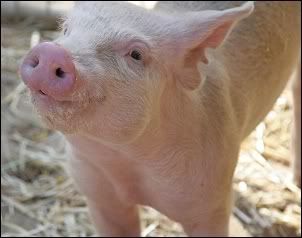
Once upon a time there was a freshly groomed piglet named Hazel.
 And then she was not (freshly groomed, that is).
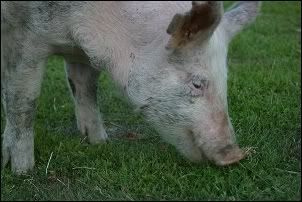
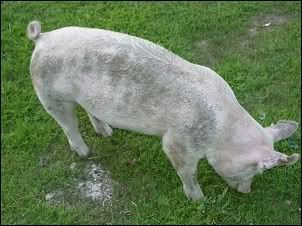
Ah, the joys of mud baths (according to Hazel, they are real joyful).
Hazel can now enjoy the simple things, like rooting in the grass and belly rubs. This wasn't always so. A few months ago, she was confiscated as part of a cruelty case because she wasn't being fed. You could see her ribs and hip bones. She had an inner ear infection and mange. She was a mess. We're grateful to have her with us - she brightens our days with her playful antics!
And then she was not (freshly groomed, that is).Ah, the joys of mud baths (according to Hazel, they are real joyful).
Hazel can now enjoy the simple things, like rooting in the grass and belly rubs. This wasn't always so. A few months ago, she was confiscated as part of a cruelty case because she wasn't being fed. You could see her ribs and hip bones. She had an inner ear infection and mange. She was a mess. We're grateful to have her with us - she brightens our days with her playful antics!
Calendar Contest Winners
Contests are fun, but we always like it when everyone wins. Nearly 40 submissions were entered into our first annual Barnyard Pals calendar contest. We selected three winners and made all other entries available for purchase with no mark-up at our cafepress store.
Here are the first, second and third place winners! Congrats and thanks to everyone who participated.
First Place: Peaches, the handsome sheep.

Second Place: Jena, the adorable bunny

Third Place: Rusty, the pretty hen

Here are the first, second and third place winners! Congrats and thanks to everyone who participated.
First Place: Peaches, the handsome sheep.
Second Place: Jena, the adorable bunny
Third Place: Rusty, the pretty hen
A will to live
Caring for farmed animals has its ups and downs. One of our pigs, Isabelle, is a shining example of both! Isabelle is a "production" pig, bred to gain weight in a short amount of time for slaughter at six months.
Because of their size, when they fall down or injure their back or hips, euthanasia is often the only option. Unlike dogs and cats or smaller farmed animals, we can't just pick up a 700-lb pig and carry her to the vet. When they go down, it's often for good.
Several weeks ago, Isabelle slipped in the mud and injured the muscles and nerves in her lower back. We put up a shelter around her and called the vet. The initial prognosis was not good, the vet suggested we consider euthanasia if she didn't show signs of improvement after a few days.
Sometimes, you just know when an animal is ready. A look, their behavior, or such clear distress the answer is simple. With Isabelle, this wasn't the case - she was alert, eating, drinking, talking to us and the other pigs...she looked like she wanted to live. We called another vet, desperate for another answer.
The vet came out and suggested electro-acupuncture. It was a last resort and if it didn't work, nothing would. We thought, why not? Euthanasia is always a final option. Since Isabelle wasn't suffering, wasn't in pain, and was acting like Isabelle, we gave it a go.
Not much changed after the first treatment. Our hopes were dimming. Isabelle wasn't giving up, though, so we agreed to do one last treatment as a last ditch effort. The vet was kind enough to provide the service for free, knowing it was an unlikely victory.
Two days after the second treatment, Isabelle boosted our hopes by getting up and walking! She walked a good hundred feet to our center pasture full of fresh grass. After a few nibbles, she collapsed from the effort. We again moved shelter to her and arranged for another treatment. By this point, Isabelle was showing signs that she could feel the acupuncture...and get grumpy about it! That she was showing signs of discomfort was good, it meant she had regained some feeling!
Finally, Isabelle was able to walk all the way up to a stall in the barn and there she's remained. She's showing gradual signs of improvement and is tentatively walking around. We don't know if she will fully recover, and we know the final option may still be inevitable. But we aren't giving up hope, because Isabelle has shown us that she has a powerful will to live.
We'll keep you updated.
-Marji Beach, Program Coordinator
Because of their size, when they fall down or injure their back or hips, euthanasia is often the only option. Unlike dogs and cats or smaller farmed animals, we can't just pick up a 700-lb pig and carry her to the vet. When they go down, it's often for good.
Several weeks ago, Isabelle slipped in the mud and injured the muscles and nerves in her lower back. We put up a shelter around her and called the vet. The initial prognosis was not good, the vet suggested we consider euthanasia if she didn't show signs of improvement after a few days.
Sometimes, you just know when an animal is ready. A look, their behavior, or such clear distress the answer is simple. With Isabelle, this wasn't the case - she was alert, eating, drinking, talking to us and the other pigs...she looked like she wanted to live. We called another vet, desperate for another answer.
The vet came out and suggested electro-acupuncture. It was a last resort and if it didn't work, nothing would. We thought, why not? Euthanasia is always a final option. Since Isabelle wasn't suffering, wasn't in pain, and was acting like Isabelle, we gave it a go.
Not much changed after the first treatment. Our hopes were dimming. Isabelle wasn't giving up, though, so we agreed to do one last treatment as a last ditch effort. The vet was kind enough to provide the service for free, knowing it was an unlikely victory.
Two days after the second treatment, Isabelle boosted our hopes by getting up and walking! She walked a good hundred feet to our center pasture full of fresh grass. After a few nibbles, she collapsed from the effort. We again moved shelter to her and arranged for another treatment. By this point, Isabelle was showing signs that she could feel the acupuncture...and get grumpy about it! That she was showing signs of discomfort was good, it meant she had regained some feeling!
Finally, Isabelle was able to walk all the way up to a stall in the barn and there she's remained. She's showing gradual signs of improvement and is tentatively walking around. We don't know if she will fully recover, and we know the final option may still be inevitable. But we aren't giving up hope, because Isabelle has shown us that she has a powerful will to live.
We'll keep you updated.
-Marji Beach, Program Coordinator