Divine Turkey Talk

Talking with turkeys is enchanting and divine. They do not use consonants and vowels but trills and whistles, clicks and melodic tweets. When they have an especially poignant point to make, their vocalization is like a goose, a honking screech reverbrating throughout the bird enclosure.

At Animal Place, there are seven turkeys, all with unique personalities and quirks. There is Willow, the mercurial red turkey who's only use for humans is when she is feeling particularly amorous. Zarriah and Serena are twins, white with black markings, the matriarchs of the main turkey clan. Finally there is Maya, the smallest of the turkey hens. Her movements are flighty, flitting from one point to the next.


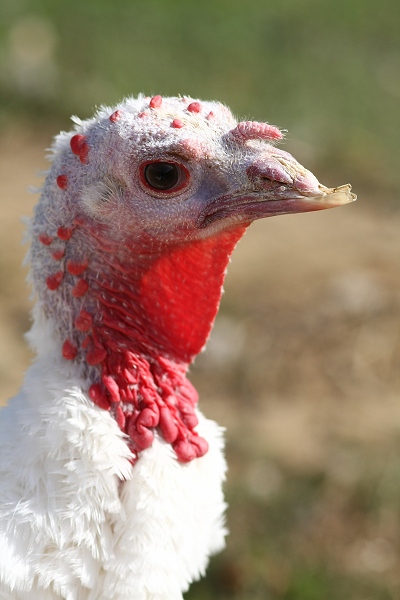
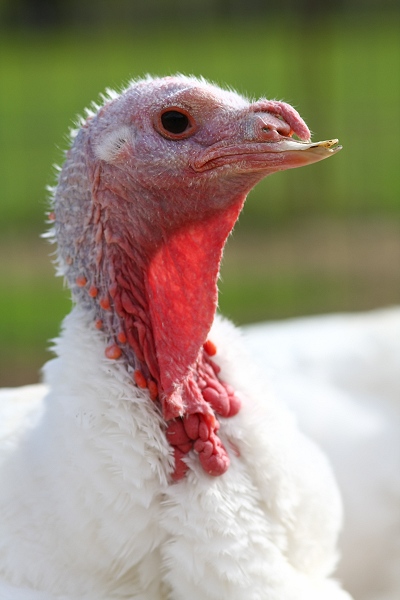
The remaining turkeys spend their time with the peepers - a sanctuary term for the birds rescued from the meat industry. Margaret (left), Mary Lou and Eliza (below right) are all who remains from a clutch of twelve peeping turkey poults. They had been saved from the life of a breeding hen, the artificial insemination, the harsh life and painful death that is the fate of all production turkeys.

All three are de-beaked, the top portion of their upper beaks mangled. Two have grown back, flimsy shadows of their former sturdy glory. Every now and then the regrown beak breaks or chips, leaving the hen back in her de-beaked state. Their feet are painful to look at, the first digit of every toe has been cut off leaving them permanently disabled, forced to limp and lurch about. De-toeing is a human comfort making it easier for catchers to sweep into the large breeding sheds and grab frightened hens by the legs without getting scratched.

It is hard not love the Turkey Trio. You can sit amongst them and hear, touch, feel their presence. If you are lucky, one might stand in front of you and croon to you a warbling tune. If you smile at just the right time, she will bestow upon you a lilting trill - you will not know what she means, but you will be grateful for the experience.

These three are old, by production turkey standards, an amazing five years of age. Their sisters have died, victims of genetics that leave them prone to heart attacks, broken limbs, poor immune systems. Margaret, MaryLou and Eliza trudge on, singing and talking their way through life. If only we could follow suit, reducing our lives to only that which is essential, welcoming friends, chastising enemies with harsh cries and nothing more, grooming and preening, existing for ourselves and one another. I can imagine this world sitting immersed among these snow-white turkeys, listening to their divine turkey talk and imagining what they might be saying.

Gadhimai Mela: Nepalese religious slaughter


Every five years, a religious festival takes place in the Bara district of south-west Nepal in which hundreds of thousands of fully-conscious animals are hacked to pieces by drunken men. It is partially funded by the government of Nepal - the fair brings in tourists and money. The festival is done to "honor" a goddess who represents motherhood (including of nonhuman animals), a deity who is supposed to help release worshippers from sin, anger, desire, stupidity. It is interesting that a group of male priests decided that the best way to worship the essence of motherhood is through the brutal killing of her children.

The fair takes place over 48 hours. In that time, between 200,000-500,000 animals are killed. It's a veritable melee of violence. Men stand outside of the temple, purchasing alcohol and imbibing large quantities. They are armed with weapons and let loose upon penned up or tied down animals. The chaos turns the marshes surrounding the temple blood red (much like the Taiji harbor during the annual dolphin slaughter or any large slaughterhouse floor in America). One cannot help but wonder how this wanton destruction of other living beings releases anyone from anger - it is the embodiment of anger and destruction, this brutal reduction of animals to chopped up parts.


Let us not be too blind, though. It can be difficult to argue against this clearly horrifying ritual without first looking ourselves in the mirror. Every year, 46 million turkeys in the United States are slaughtered for what appears to be a ritualistic celebration of life - Thanksgiving. Their bodies are displayed prominently in the center of the table and their limbs are consumed as part of a feast of thanks and gratitude. On a scale, certainly the American slaughter of turkeys is far greater than the Gadhimai Mela festival. The brutality is no different, although slaughterhouse workers are not permitted to consume alcohol prior to eviscerating turkeys. And, there is no denying it, American consumers pay for the slaughter of 10 billion land animals every year. That's 320 animals every second of every day. At the Gadhimai Mela festival, an animal is killed every second of the 48 hour festival.

Blogging about this isn't easy. Nepal is far away, there are injustices perpetrated against animals in our own backyard. Still, it is hard not to imagine the terror and fear these animals experience. It is no different than what any animal experiences, no matter their location. I just cannot get out of my head the vision of drunken humans bearing down upon frightened, screaming buffaloes, goats, pigs, chickens, rats, pigeons...hacking, tearing, covering themselves in the blood and excrement of dying animals. It breaks my heart.

Maneka Gandhi wrote a brilliant and eloquent op-ed piece about this festival. She is certainly more of an expert on the region than I am - please read it. She explains how this is a festival of exploitation - of the animals, of women, of the participants.

Animal Nepal has campaigned to stop this bloodletting (there are a couple other events that are equally hideous, including the Khokana festival which involves throwing a 5-6 month old male goat into a pond and allowing 5-6 men to literally tear the goat apart. I mean, literally. It's disturbing). On the linked page are some tips for if you live in Nepal (which I am assuming most of the readers of this blog do not) and tips for those of us living outside of Nepal:
When you live outside Nepal:
  • If you travel to Nepal please don't travel with tour companies who organise tours to temples where animals are sacrificed.
  • While in Nepal rise the issue during your discussions with those you meet.
  • In your own country if you meet any Nepalese or have Nepalese friends ask them what they are doing to stop animal sacrifices in Nepal.
  • Please do write to the Nepalese Embassy in your country, to the Nepalese Government and Nepalese media to enact laws to stop these extreme practices. 

Every thing we do in our lives should be toward a better, more humane, kinder world. This applies to all of us humans, all of us. With our actions, we send messages about who we are and how we want to be perceived. We cannot create a better world when we continue to see nonhuman animals as commodities or when we oppress women or exploit certain sectors of the population. These rituals, no matter their country of origin, have no place in a compassionate society. None. Cultural differences aside, we are all sharing a planet, all members of this global network of life. We are humans and they are nonhumans, but we all experience joy, form friendships, suffer, feel pain, and have desires/wants of our own.

Other stories on this subject:
Buddha Boy (Palden Dorje Tamang Rinpoche) will set up camp, bless the animals and try to peacefully stop the slaughter.
Animal Nepal's Petition you can sign

Controversy over new global warming report


A new Worldwatch report claims 50% of all global emissions of greenhouse gases can be attributed to livestock production.


This article attempts to refute the 2006 report Livestock's Long Shadow which blamed livestock production for 18% of all anthropogenic sources of greenhouse gases.


What is surprising about Worldwatch's report is its suggestion: Stop eating meat. Don't just reduce consumption, change what you eat from meat products to analogs. They essentially suggest that the most meaningful way we can reduce our global greenhouse output is to go vegetarian.


A few caveats deserve to be mentioned. The analysis has not been peer-reviewed; that is, other scientists and experts have not pored over the data and drawn similar conclusions. According to one leading expert on climate change, Tara Garnett, the data is certainly welcome, particularly the information on methane, but that the data on carbon dioxide emissions from livestock breathing may not be accurate. Further, the conclusion drawn from the methane information may be skewed due to lack of equalization across all industries (i.e. the authors did not apply their statistics equally to all methane-producing sectors).

Karl Burkart over at Mother Nature Network offers some criticisms to the report. While there is no doubt Burkart and Animal Place come from two different philosophies, there is fairness in his criticism.

Of course, the ultimate conclusion is still valid - the reduction or elimination of meat, dairy and egg products from our diet is beneficial to us all. It improves our health, reduces our impact on the environment and, obviously, reduces the suffering and exploitation of other animals.

Free study guide and film for educators

Study guide and film FREE to teachers! Animal Place is proud to announce the creation of a curriculum unit on farmed animals for secondary teachers! The 50-page study guide accompanies our film, The Emotional World of Farm Animals, which has been aired nationally on PBS. The Emotional World of Farm Animals study guide cover
Geared for all ages, this study guide introduces students to the intelligence and emotional states of cattle, pigs, chickens, turkeys, goats and sheep.

If you are a teacher interested in receiving a FREE copy of our study guide AND PBS-aired film, The Emotional World of Farm Animals, please fill out the registration form.

Our thanks to the Glaser Progress Foundation & the Animal Welfare Trust for funding this project.

Film also available for purchase!

The film can be purchased on-line for $20.

Cooperatives Working Together to Kill Cows

I know I've been blogging a lot about the dairy industry these past few days. I promise I'll be blogging about other farmed animal and Animal Place related issues soon, but this article was brought to my attention. I had to post about it, it's just so creepy and Halloween is right around the corner, so it seemed appropriate.

Living in California, the largest dairy state, it's hard not to hear about the "plight" of dairy farmers. Feed prices are up. Milk prices for producers are down significantly. Farmers are left with decisions to make and who do they turn to when times are tough? Apparently, Cooperatives Working Together - a collection of dairy co-ops that get to benefit any time a down-and-out-of-luck dairy farm participates in their herd retirement program.

You heard that right, herd retirement. If you are a cynic when it comes to the language industry uses, you probably laughed darkly at that nice little term. If you are unfamiliar with the way agri-business spins and twists and confuses with language, then you might think herd retirement was synonymous with green pastures and nice, new cow sanctuary digs. Or maybe you do realize that herd retirement = slaughter. I mean, I know people generally like to consider a permanent retirement from the work place, but this is a bit of an extreme interpretation of the word.

If you're like this farmer, this is how hard the decision to retire your herd might be:
"He said it was the hardest thing he ever had to do," she said. "Luckily, my boys could do it."
Yes, it must have been downright tough-as-nails hard carting off 1,500 cows to slaughter. Lucky!! Someone else did it for this guy. Left out of the equation are the cows. You know the herd about to be retired? How do you suppose they felt being crowded into metal containers, transported miles to the nearest abattoir, unloaded, poked and prodded, shoved and pushed, forward motion to the man or woman who would punch a hole in their heads, cut their throats, butcher their bodies?

I am a compassionate person. But let's face facts, here: This family (and in all honesty, I wish them economic success w/o animals) has profited off of the exploitation and use of another species without their consent. These cows have had thousands of gallons of milk taken from them for people to drink, they have given birth to calves they've never nursed. This is their send-off gift of retirement? Well, it is just sooner than normal - all dairy cows are slaughtered, of course, even when they could live another decade.

Back to the Cooperatives Working Together (CWT). They even have a program where you can include all of the bred heifers in the herd. Bred heifers = pregnant. It does not matter if the cow is 45 days pregnant or full-term, nine-months pregnant - CWT will buy them for a flat fee of $700/cow. What happens to these pregnant cows? Their babies? Generally the cow is stunned and her throat cut. Inside her, the calf - if he is full-term - will struggle with her as she dies (for as she dies, so does he). The cow may then be cut open and her fully-conscious or, by then, dead calf removed from her womb. The calf may be used for research, his blood pumped from a still-beating heart to make use of their fetal blood serum. This is done without anesthesia. The calf might just have her throat cut as well (without a stunning blow to the head) and be processed alongside her mother. Mostly, the calves will be cut from their mother's body and their skin turned into soft leather. That last link has a video. It's graphic, you have been warned.

This year alone, CWT has paid for the slaughter of 225,000 cows. That's almost as many cows they've paid to kill since they formed in 2003. Around 55,000 cows are being killed per week - that's 7,850 cows a day or 327 cows every hour being slaughtered. Generally, around 2 million dairy cows are slaughtered annually, but at the current pace, another million - 3 million total - will be killed. 

So who benefits from the CWT? Certainly not the cows and calves - they're killed. The farmers who "retire" their herds? The money they get per hundredweight of their cows is hardly worth calling home about. It certainly won't help the farmer retire. They have to sell their entire herd to benefit from the CWT program and they can't use that money to buy more cows. Member groups certainly benefit. They're buying into a system that winnows down a diverse group of farmers to a small, more homogeneous group of farmers (those big co-ops, primarily). They certainly benefit from less competition. That does not seem like a good thing for anyone.

Help give cows a real retirement by supporting sanctuaries and vegan outreach groups. Reduce the amount of money you spend on animal products, choose alternatives, try veganism. These are meaningful ways to help animals.

Milking it

Sadie is special, at least to me. She is the face of the dairy industry, those beautiful cows who are bred and milked, bred and milked in a cycle of loss and separation. In her life, she gave birth to four calves, their fates intertwined with her own. Each calf was a marker of loss for Sadie, torn from her at birth. She did not nurse or groom them; she never watched from a distance as they frolicked in green pastures. There was never a time when she met grand-calves, the young of her own daughters.

Her sons, sweet and smart, gentle and curious, they are all dead now. Sold at auction for $5-15, raised and slaughtered for veal or cheap dairy beef. None of them made it past the age of two.

Some of her daughters are alive, no doubt. Others are dead, slaughtered and disassembled for what meager flesh humans can obtain from their overworked bodies.

She spent six years at a dairy farm. Six years of producing gallon after gallon of breast milk for another species. Every meaningful behavior, from reproductive choice to nursing her own young to choosing what and where to eat, all of them denied.

And when her production decreased, when an infection common to 50-70% of all dairy cows invaded her mammary glands - suddenly she was no longer a valuable commodity. She had never been seen as someone, an animal with interests of her very own, but as a something, a unit of production whose worth was measured in gallons.

She was sent to auction. That awful place where other sentient beings are paraded in front of humans, where they are watched from bleachers, where they piss and shit in fear, where they cry. And where they go unheard. She was purchased by a veterinary university and used as a teaching tool. Her mastitis was left untreated,  yet another chapter of exploitation.

Someone saw her as an individual and ached for her. They saw a sweet animal who was struggling to survive amidst poking and prodding and a painful medical condition. It was an orchestrated production of frustration trying to convince the university to release her to the sanctuary. But in the end, she arrived, shy and concerned, an udder that sank nearly to her knees, a sign of human cruelty, of every milk-drinker's complicity in her suffering.

I will be honest, Sadie is never going to like humans. It has taken me years to touch her, to scratch her face like a bovine friend would. She tolerates my presence because I am a known entity, a biped who has given her apples and massages and has yet to do anything to violate the tentative trust built.

Her mastitis took years to heal. Years. It was only through NOT MILKING her, through the painful removal of cup after cup of pus and infection did it heal. And it was only because her caregivers, people who wanted nothing more than for her to get better, had to confine her, force her to suffer even more indignities. She endured, unwillingly, and it pained us to watch.

Life for Sadie now is one of choices. Like where to graze or nap. Or what to do with herself at ten in the morning. Or whether she wants to hang out with the other cattle or lie in the compost pile on her own. When we take in male calves from the dairy industry, the unwanted by-products, she decides whether they get a facial grooming or a back grooming. There are still times when we take decisions away from her, like when she needs hoof trims or pain medication. We hope that these are minor inconveniences and her life is generally full of good, positive, enriching experiences. She deserves them.

Whatever your reason for being vegan or striving toward veganism - thank you.

Some more pictures from yesterday (click to see larger):
     

Kinder side of veal?

Humanely raised veal? Veal cast in a kinder light?

Today's Washington Post offers its readers a look into a kinder, gentler, more humane veal.


Wait a second, back up. Look at that language, how it muddies up the discussion right off the bat. Veal is not raised. There is no field of veal stalks reaching tendrils to the sun. Veal is the flesh of calves, specifically young male calves. It's calf meat or flesh.

Its producers argue that if male calves, an otherwise useless byproduct of the dairy industry, are not ethically raised for meat, they are sold to less-humane veal producers or destroyed.

Ouch. Let's be honest about who we are talking about. By-products are inanimate, they have no real moral value. They are things.

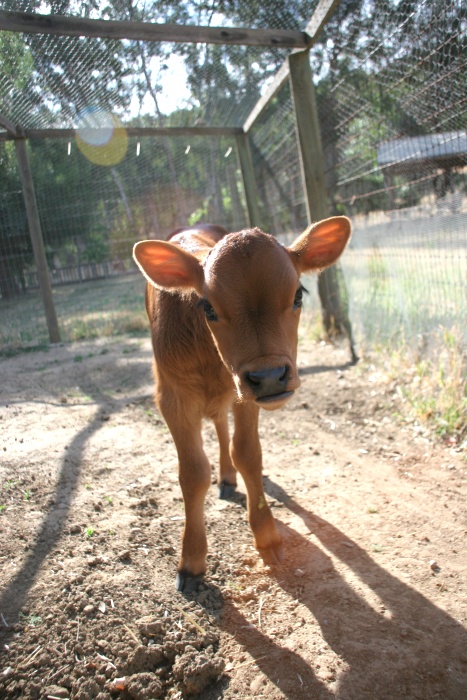
He is not a thing:

This animal you see above is not inanimate. He has wants of his own that often do not align with mine or yours. His personality is different from other cattle. He has emotions and intelligence. I am not using this picture as an attempt at appealing to emotion (but oh goodness, isn't he cute?). But when you see this calf, you do not see veal or a by-product, you see an individual, a breathing, feeling, moving animal.


Then there is the notion that gosh, people, if we do not start sending calves to pastures where they can be fattened and slaughtered in a less cruel manner, then we are guilty of sending them to horrible, evil, operations where animals cannot even turn around. Like most animals, a calf has an interest in life. Perhaps not an interest in pondering ethical matters, like us humans, but an equally valid interest in pursuing all the behaviors that keep him alive. He avoids things that cause him pain and fear. It does not matter if he is sent to a green pasture before he is killed or if he spends 20 weeks in a tiny crate before he is killed. He is killed. His life, which could extend for more than a decade, is denied him.

For what?

A beverage humans do not need in any manner, shape or form to survive. Dairy milk is not intrinsic to our survival. We are, in fact, the only species to consume the breast milk of another past weaning.

The article goes on:
For example, one common consumer complaint is that the animals are killed so young. But veal calves are in fact older than chickens, turkeys and pigs and about the same age as lambs when they are slaughtered.
Fear no more - calves raised for veal are older than other slaughtered animals! It's true, calves raised for rose veal are slaughtered when they are between 6-10 months of age, depending on the farm and location. Most are killed when they are 6-7 months of age. This is actually the same age as pigs and lambs (who are generally 5-7 months old) and definitively older than chickens raised for meat (who are a tragically young 6-weeks-old). Some turkeys are slaughtered at 6-mos-old, while most are around 4-mos old.

This begs the question: SO WHAT? That question deserves capitalization. There's a good post over at Change.org's Animal Rights about this very issue. The reality is that a six or ten month old calf is still a baby. Behaviorally he is a young animal. Physically he is immature. That he happens to be older than other young animals is hardly a winning argument for eating his flesh. Consumers! Please be smarter than that (I have faith you are, seriously). All animals on farms are killed before their normal lifespan.
Most important, dairy cows must give birth to provide milk. "If you consume dairy, you should eat veal."
This is irrefutable. But I have a different take on it. Instead of eating veal, stop drinking milk. You don't need it. It's made for a bovine baby. It is a non-essential nutrient. There are alternatives. You can get the added supplements and nutrients from other sources. Stop drinking milk, stop supporting veal. It really is that easy.

Because it all comes down to this:
"I think it's really tasty," said Bart Vandaele
Taste. Palate. Gustatory pleasure. I love food. Really, I do. There are so many variations of grains, so many varieties of vegetables and myriad fruit. There are nuts and legumes. The combinations are endless (statisticians may disagree). But can taste be a serious argument for raising animals for their flesh, milk or eggs? Can the fact that something is "tasty" excuse the commodification of another intelligent, emotional being? Can it excuse the separation of mother from calf the day he or she is born? Is the suffering and oppression of entire species' less important than liking how something tastes?


We cannot be that arrogant, that selfish. Can we?

Windy days, unimpressed animals, learn to save

In a move only described as Epic Fail, I managed to delete the incredibly amazing, provocative, insightful, WILL CHANGE YOUR LIFE post I was writing. I cried a little.

Now you will have to settle for the following.


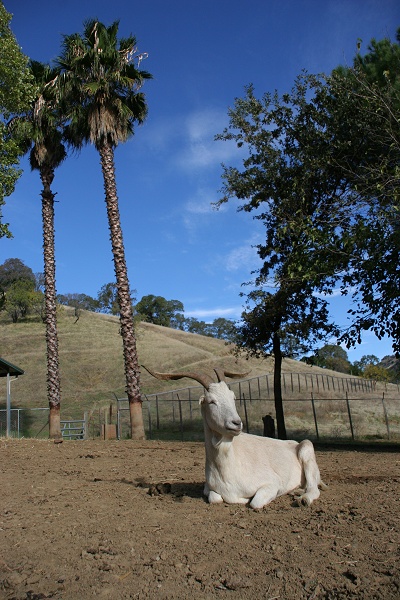
Here is Willy. He is a goat, as evidenced by his horns, beard and caprine-like appearance.

Today is a very windy day - you can tell by the fact that the palm tree is about to topple over. Just kidding. Or am I? You would have to be present for the picture to know for sure.

If you look closely, you can see Willy's beard dancing in the wind to its own drumbeat.

I tried to get Willy to do something a little more exciting than lying down. So he turned his head to the side. You are as excited as I am by that pose, aren't you? Yes, well, goats rarely do what you ask them to do. This is a good thing, because even when goats do as you ask, they do it in such a way as to make your life a little harder. Funnier. But harder. Like for example, one time I asked Jeffrey to get his own leaves from the tree. So he attempted to use me as a climbing device. This was painful AND funny (in hindsight).

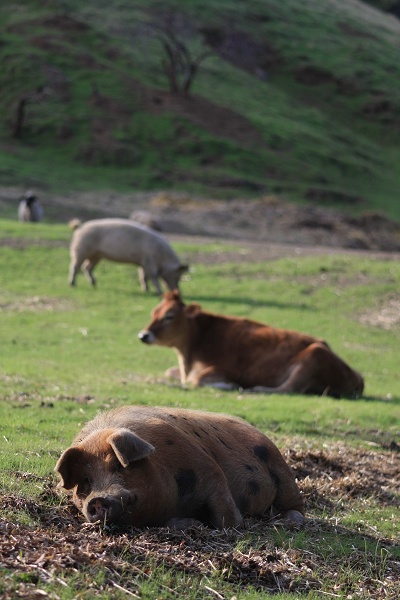
Moving on to some other animals and their methods of wind protection. Did I mention it is windy today? Oh yes, the palm tree. Anyways, it's gusty. I feel as if I might blow away at a moment's notice, yet the animals are all unperturbed.


Bruce is the pig in front. You can read his story here. It's a tear jerker.

He is snoozing as he is wont to do and, if you had been there, you would have seen his ear would flap upwards due to an unruly burst of wind. It was cute, yet I failed to get a shot of it. I apologize.

Behind him is Nicholas. To be honest, I am grateful Nicholas wasn't acting as if the wind was the best thing since alfalfa. If so, he would have been up, kicking and bucking, most likely within a two-foot radius of me. In play, jest, haha, you are so funny! I like not getting injured by frolicking bovines, so Nicholas is absolutely gorgeous lying there in the green, green grass.

Hazel is the blurry pink pig in the very back. And there is not much else to report about her, except that she was being the most exciting animal in this shot. LOOK AT THAT HIND LEG ABOUT TO MOVE!

And then there were the chickens. Oh, chickens. Surely there would be rambunctious hens and cavorting turkeys. They would be testing their wings on the updrafts, soaring high. Just kidding, they don't do that sort of crazy stuff. I mean, they could if they wanted to. But they do not. Want to soar on the updrafts, that is.

Instead they want to do stuff like this:


You cannot get much more awesome than Diablo and his blowing mane of feathers. YOU CANNOT. I mean, you could try, but you would fail and you would feel embarrassed that you thought you could. Try to make sense of that statement. Diablo was the ONLY chicken out in the grass. His head-feathers were blowing stylishly in the wind, his comb and wattles bright red and quite an appropriate testament to his namesake El Diablo.

If this changed your life, then my epic fail of before was not in vain - PLEASE TELL ME IT CHANGED YOUR LIFE. Diablo will thank you.

Taylor the chicken, mourning her friends


Meet Taylor, the hen, my friend and confidante (on all things chicken, mainly). She is a singer, a crooner, a speaker on all subjects large and small. Who stole her nest box. Who is hanging out with Diablo the rooster when they were last seen with Newman. Who likes Ferdinand, even though he's kind of a jerk. Why Willow the turkey pecks at Joan Jett, the hen.

Everything is fair game.

Yesterday, Taylor sat on my lap. She trilled and grumbled at the rest of the birds. Here she was, on stage, ready to perform for all of her chicken peons. No one seemed to be paying much attention. She had mine, though. Eye contact, direct and forceful. A small connection. This was serious talk.

Arching her speckled neck, she reached up and tugged on a strand of hair, tug, yank, pull. Ouch! My yelp gave her pause and she cooed like a hen does to a miffed chick. It's a sweet sound, full of maternal love. When you hear this sound, do not keep up with your temper tantrum. A hen's maternal love lasts only so long, soon she will change her tone and reinforce her message with a swift peck to the head. I quickly got over the pain - she was giving me the "I will peck you if I have to" look. Mothers can be tough.

I have found Taylor's sweet spot. Reaching my fingers up, I scratch along both sides of her neck. Scratch, scratch, massage, scratch. Her eyes close, she makes these indescribably precious sounds. Happy! If she were a dog, she would be kicking her hind foot in wild abandon.

There is no denying Taylor's pleasure, no ignoring her contented sighs and clucks of appreciation. You do not need to be an expert on chickens to observe Taylor and see a being who thinks, feels, experiences the life around her.

The more you get to know another species, the harder it becomes to excuse their exploitation and abuse. Chickens are fascinating animals. Their world is sometimes unfathomable to me, but many times it's so obvious - friendship, trust, betrayal, hunger, love, altruism, fear, suffering, pain, joy. Their movements are not pointless reflexes, random responses to their environment. They think and plot and make decisions. Which makes their treatment on farms so painful. Nine billion. 

24,600,000 killed every day. By the time you have read this sentence outloud, nearly 2,000 chickens - with unique personalities like Taylor's - have been slaughtered in the United States alone. They are not protected by federal slaughter laws. Some states exclude them from state slaughter laws. This means they can be killed fully conscious, no stunning required.

The numbers alone highlights their unbearable suffering. It is impossible to slaughter 24 million birds every day without stunning improperly, not fully killing birds before their still feeling bodies are dunked into electric baths or de-feathering machines. There are not 24 million slaughterhouses for each bird. They are killed by the tens of thousands in the few processing plants that exist solely to disassemble living, sentient animals.

Chickens are not dumb. They are not immune to pain. They are intelligent, emotional beings who can and do suffer. Their desires are not much different than yours - they want to live, seek out that which makes them happy, avoid pain, make friends, eat until they are full (and they like sugary sweets!), spend time with their family and loved ones.

We owe them. We have murdered them by the billions for decades. We owe them.

Please go vegan.

Backyard Poultry Position Statement

Collective Position Statement on Backyard Poultry
 
Background
In the past year, shelters and sanctuaries in urban and suburban areas have witnessed a dramatic increase in the intake of chickens, particularly roosters. Hatcheries producing day-old chicks for shipment to feedstores and individuals are backlogged with orders. The desire to raise poultry can be linked to organic backyard farming as well as a desire to have direct access to food (eggs and, in some cases, meat).
As a coalition of animal sanctuaries concerned for the welfare of hens and roosters, we have created this position statement on the keeping and raising of chickens. All of us have received calls to take in hens and roosters who are a) no longer wanted; b) not the correct sex; c) not legally permissible. As organizations with limited resources and space, it is no longer feasible to take in even a small percentage of these sadly unwanted birds. Even with placement assistance, most of these chickens, particularly roosters, do not find permanent placement. This leaves municipal dog and cat shelters the task of taking in, housing, feeding, caring for, and inevitably killing healthy, adoptable chickens.

Problems associated with urban backyard flocks
Hatcheries are like puppy mills: When animals are reduced to commodities, their interests are pushed aside in favor of profit. Hatcheries that produce chicks for backyard flocks treat chickens and their offspring the way puppy mills treat breeding dogs and their puppies. As there are no legal requirements dictating how breeding hens and roosters are housed, they’re most likely crammed into small cages or sheds without outdoor access.

Shipping day-old chicks is cruel: Most chickens purchased are bought from hatcheries or feed stores (feedstore chicks originate from hatcheries). Hatcheries ship day-old birds through the postal service without any legal oversight. Young chickens are deprived of food and water for up to 72 hours and exposed to extreme temperatures. As Dr. Jean Cypher, a veterinarian specializing in avian medicine states, “A day-old chick can no more withstand three days in a dark crowded box than can any other newborn.” Other experts in avian medicine and behavior agree that transporting day-old chicks in boxes for the first 24-72 hours of life is cruel and medically detrimental to the birds. 

Chicken sexing is more art than science: Using data collected from sanctuaries and rescues that field calls daily about unwanted chickens, we estimate between 20-50% of purchased “hens” are actually roosters. Depending on breed, visually identifying a rooster can take weeks to months.
Roosters may be unwanted and are often illegal: Male chickens are generally unwanted for two reasons: They don’t produce eggs and they are rarely legal in urban or suburban settings. Hatcheries may use rooster chicks as packing material, regardless of whether they were ordered. Most incorporated or urban regions that do permit chickens allow only hens, not roosters. Unwanted roosters may be abandoned to the streets, slaughtered, or end up in a municipal shelter to be killed. Very few find their way into a permanent home or sanctuary.
Chickens attract rodents: Even the cleanest coop is attractive to rats and mice who enjoy the free bedding (straw and shavings) and food. Rodents are generally viewed as pests and their presence is unwanted by chicken owners and neighbors.
Lack of professional medical care: Avian medicine has made progress but there are few vets specialized in the treatment and care of birds. Veterinarians who do treat poultry are often expensive, with a veterinary visit sometimes starting at a minimum of $100.
Concerns with new ordinances allowing backyard poultry
Enforcement costs: Municipal shelters run on a tight budget dealing with animal cruelty cases, dangerous dog calls, and the normal day to day operation of their facilities. Adding an extra burden, like enforcing chicken licensing laws and related complaints, is unwise amidst current economic concerns.
Slaughter: The average chicken guardian is ill-equipped to “properly” stun and kill a chicken. Further, slaughtering can be traumatic for neighbors, including impressionable children. If chickens are to be permitted in urban areas, they must be protected from cruel mistreatment, including a ban on slaughtering them for consumption.
Roosters will be killed: Creating new ordinances permitting chickens creates a market for killing 50% of all chicks born in hatcheries. Urban and suburban areas considering chickens generally ban roosters, yet male chickens comprise half of all chicks born. Hatcheries mail roosters as packing material, and sexing of chickens is more art than science (see above). When residents purchase chicks from hatcheries or feedstores and end up with roosters, they will be put in the position of having to rehome the bird(s). Most roosters are not rehomed and end up abandoned or dumped at shelters, where most will be killed.
Suggestions if you are considering a backyard flock
Make sure it’s legal: If you live in an unincorporated area, contact your planning department and ask about the zoning requirements regarding poultry. If you live in an incorporated region, contact the city clerk for information on ordinances regarding chickens.
Adopt: Avoid the cruelties of the hatcheries by adopting birds already in existence who need homes. Check out www.petfinder.org for animals available at your local shelter. Visit www.sanctuaries.org or www.farmanimalshelters.org and contact a sanctuary near you about adopting birds. If they do not have birds, do not give up. Sanctuaries and shelters receive inquiries daily regarding animals needing homes – ask that you be contacted if a chicken becomes available who needs a home.
Do your research: Chickens can be wonderful companions. While they are relatively easy to maintain, they do have special needs. Be sure to research housing, predator proofing, diet, and medical needs. Some things to be aware of:
  • Some breeds of chickens are cold-sensitive: Hens and roosters with large single combs are prone to frostbite in cooler climates. Make sure adequate housing accommodates birds in both cool and hot temperatures.
  • Predator protection is vital: Chickens should be locked up at night in a safe enclosure that prevents access by all predators, including dogs, raccoons, aerial predators, rats, cats, wild canines, weasels, etc. During the day, animals should be housed in a fully-fenced enclosure or yard with proper protection from aerial, day-time predators and neighborhood dogs and, in the case of small bantams, large domestic free-roaming cats.
  • Veterinary care is critical: Avian medicine is still considered an “exotic” practice and, as such, is more expensive. A one-time visit may start at $100. Nevertheless, before considering housing chickens, it is imperative that they have access to veterinary care.
Supporting Organizations